
History · 7 min read
The First Watches: From Henlein’s Portable Clock to the Wristwatch
The watch is not an ancient object. Clocks are old, sundials are older, but a timepiece small enough to carry begins around the year 1500, and one small enough to strap to a…
The watch is not an ancient object. Clocks are old, sundials are older, but a timepiece small enough to carry begins around the year 1500, and one small enough to strap to a wrist does not appear until the nineteenth century. Five hundred years is a short span for something that now looks inevitable, and the interesting part of the story is how many separate inventions were needed — the spring, the balance spring, the jewel bearing, the waterproof case, the tuning fork, the quartz crystal — before a watch became the thing you are thinking of.
Before the watch: clocks you could not carry
For most of history, timekeeping lived in buildings. Tower clocks, then domestic clocks, were driven by weights hanging on a cord: gravity pulled the weight down, and the mechanism turned as it fell. The arrangement is simple, reliable and completely immovable. A weight needs height, and height is what "portable" cannot provide.
The problem that had to be solved was therefore not miniaturisation in the abstract. It was finding a way to store energy without gravity — a spring that could be wound tight and would release slowly. Once coiled springs were understood well enough to do that, the watch became possible and every subsequent advance was a refinement of the same idea.
Around 1500: the first portable timepieces
The conventional answer to "when was the first watch made" is around 1500, in Nuremberg, and the name attached to it is the locksmith and clockmaker Peter Henlein. What he and his contemporaries produced were not watches in the modern sense. They were small, drum-shaped cases of brass or gilt, carried in the hand or hung from a chain, with an hour hand and no minute hand, and they needed winding once or twice a day.
Their accuracy was poor by any later standard — plausibly off by a quarter of an hour in a day — and their chief virtue was that they were portable at all. Nuremberg became the centre of the trade, and the objects are still described by the name the trade gave them: Nuremberg eggs, though the surviving examples are mostly not egg-shaped. That is the sort of detail that survives better than the objects do.
Three qualifications are worth keeping:
- No single object is provably first. The attribution to Henlein rests on later town records and on reputation rather than on a documented moment of invention.
- Several people were solving the same problem. Spring-driven timepieces appear in the record in more than one place within a few decades, which is what one expects of a technology whose time had come.
- Dates vary by decades in the sources. You will see 1500, 1505, 1510 and 1524 for the same claim. Anyone quoting a single year to the day is overstating the record.
Why they were called watches
The word came from the night watch, not from the act of looking. A watch was a device for keeping track of the hours of a shift, which is why early references treat it as a working tool for people who needed to know when their turn ended. The sense we use now — an object you wear — is considerably later.
Seventeenth century: the balance spring, and timekeeping becomes timekeeping
The single biggest improvement in the history of portable timekeeping arrived in 1675, when Christiaan Huygens applied a spiral spring to the balance wheel. Before it, a balance swung at a rate set largely by its own inertia and by the push of the escapement, which drifted with temperature, position and how wound the watch was. With a spring controlling the oscillation, the balance had a natural period that the mechanism could actually hold.
The effect was not incremental. Minute hands became meaningful, then normal. Watches stopped being devices for roughly knowing the hour and started being instruments, and the trade reorganised around the new possibility: jewels as bearings, refinements to the escapement, and a long argument about how to compensate for temperature that occupied the best makers for the next century.
1810: the first wristwatch, made for a queen
Wristwatches existed as an idea for a while before anyone made a serious one. The breakthrough object is well documented and, unusually, well documented by the maker itself: Abraham-Louis Breguet completed a watch in 1810 for Caroline Murat, Queen of Naples, the sister of Napoleon.
It was an oval repeater — a watch that chimes the time on request — fitted with a bracelet of woven hair and gold thread. Breguet's own records describe it as a watch to be worn on the wrist, which is why it is credited as the first. It was also, in every sense that mattered at the time, a piece of jewellery made for one remarkable customer rather than the start of a product category.
Two things follow. First, the concept of a wristwatch is older than the twentieth century by a wide margin, which contradicts the popular version of the story. Second, that watch does not survive, so the oldest surviving wristwatch is a different object.
1868: the oldest surviving wristwatch
In 1868, Patek Philippe made a wristwatch for Countess Koscowicz of Hungary. It is the earliest wristwatch known to survive, and it is held in the Patek Philippe Museum in Geneva. Like the Breguet, it was a piece of jewellery in a rectangular case with a decorative bracelet, and like the Breguet it was a one-off for a client rather than a product line.
The distinction between the two objects is worth holding onto, because it is exactly the distinction that gets lost in retellings:
| Claim | What it actually means |
|---|---|
| First wristwatch, 1810 | Breguet, for Caroline Murat. Documented in the maker's records; the object does not survive. |
| Oldest surviving wristwatch, 1868 | Patek Philippe, for Countess Koscowicz. Held in the Patek Philippe Museum. |
| "The wristwatch was invented in 1904" | This refers to the Cartier Santos, an aviation watch made for Alberto Santos-Dumont — a landmark in making the wristwatch practical and fashionable, not the first wristwatch. |
1900s to 1920s: the wristwatch becomes an instrument
For the first years of the twentieth century the wristwatch was still mostly a woman's item and a soldier's improvisation. The First World War changed the terms. A watch that could be read at a glance without being taken out of a pocket is a genuine advantage in the field, and hundreds of thousands of men came home used to wearing one.
The engineering caught up in the same decade. Rolex's Oyster case in 1926 was the first commercially successful approach to a genuinely sealed watch, and the point of it was not elegance: a watch you could not keep water out of was a watch that would not survive daily wear. Waterproofing, shock resistance and the automatic winding that followed in the 1920s and 1930s are what turned a fragile ornament into something that could be worn without being thought about.
One date to treat carefully: the first automatic wristwatch is usually credited to John Harwood, whose design was patented in 1923 and reached the market shortly after, but sources differ on the exact year of the commercial release. Cite it as the early 1920s rather than pinning it to a single date.
1969: quartz, and the industry changes shape
The last genuinely discontinuous change arrived on 25 December 1969, when Seiko released the Astron 35SQ in Japan — the first quartz wristwatch offered for sale.
Its significance was not that it was more accurate than the best mechanical watches, though it was. It was that the accuracy came from a crystal and a circuit rather than from hundreds of precisely made mechanical parts, which meant that once manufacturing scaled, a cheap watch could keep excellent time. Within two decades the mechanical watch had gone from the default to a minority enthusiasm, and the industry that had spent three centuries refining the lever escapement had to find a different reason to exist.
That reason turned out to be the object itself: what a mechanical watch does well is not keep time, and the quartz crisis is where the modern watch market — mechanical as luxury, quartz as equipment — begins.
How this connects to the calculator watch
A calculator watch is the direct descendant of the quartz change. Its accuracy is inherited, not earned: the hard problem had already been solved by 1969, and what the 1970s added was the packaging — a keypad, a chip and a display squeezed into a case a few millimetres thick, at a price that made it a consumer product.
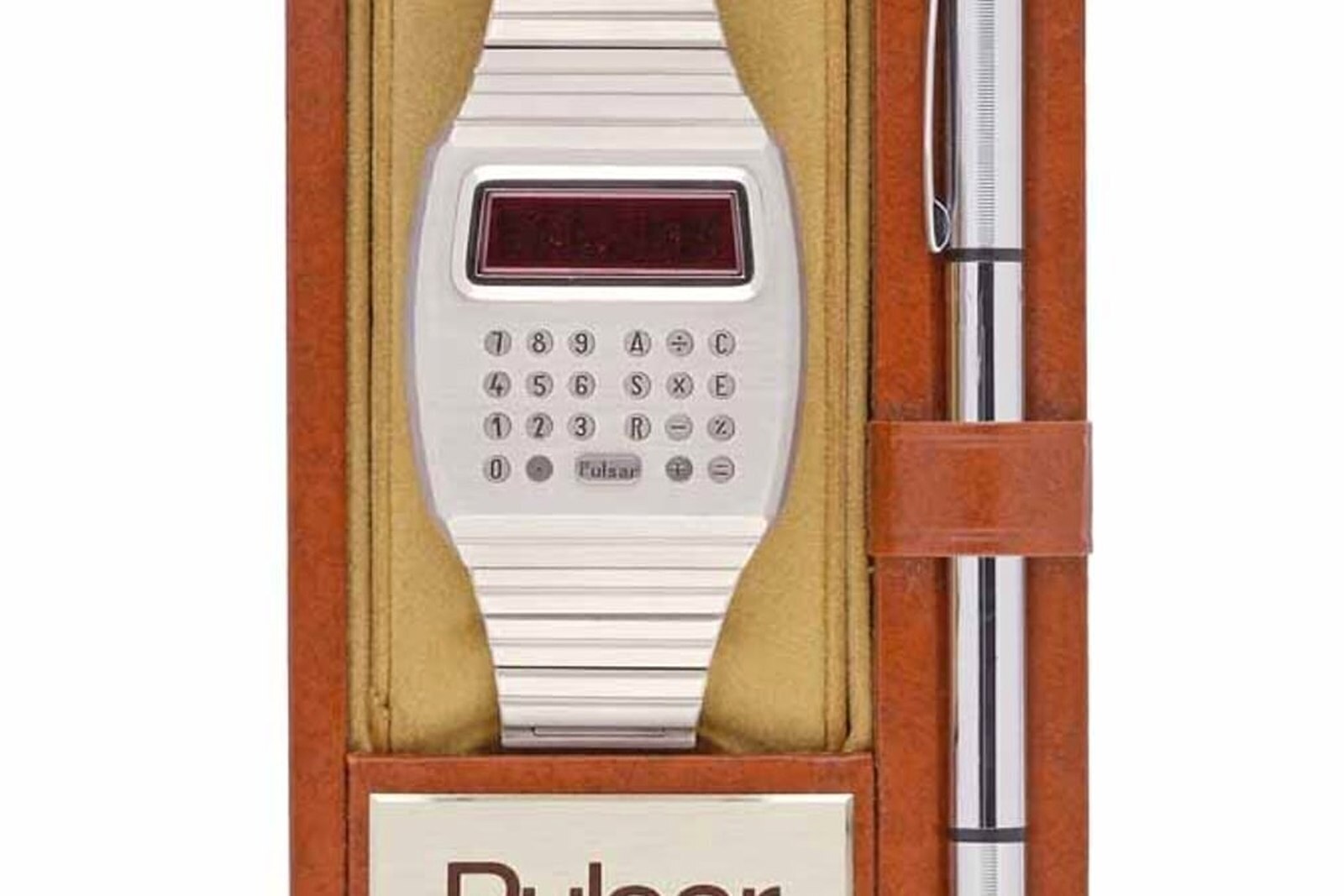
The first calculator watch proper arrived in 1975, from Pulsar, and Casio's contribution was to industrialise it. Our history of the calculator watch picks the story up there and carries it through to the present, and the Casio guide covers the model families that came out of it. If you want to understand the machinery underneath rather than the dates, the guide to gears and movements explains what the quartz revolution replaced.
Dates worth keeping straight
- c. 1500 — first portable spring-driven timepieces, Nuremberg; conventionally attributed to Peter Henlein, not provably by him.
- 1675 — Huygens applies the balance spring, making minute indications meaningful.
- 1810 — Breguet's wristwatch for Caroline Murat. First wristwatch; does not survive.
- 1868 — Patek Philippe for Countess Koscowicz. Oldest surviving wristwatch.
- 1904 — Cartier Santos. The wristwatch becomes practical and fashionable, not invented.
- 1920s — Harwood's automatic, and Rolex's Oyster case in 1926. The watch becomes wearable equipment.
- 1969 — Seiko Astron 35SQ, 25 December. Quartz arrives.
- 1975 — Pulsar's calculator watch. Quartz gets a keypad.
Frequently asked questions
When was the first watch invented?
The conventional answer is around 1500, in Nuremberg, and the name attached to it is Peter Henlein. The honest qualification is that no single surviving object is provably the first, the attribution rests on later records rather than on a documented moment of invention, and clockmakers in several cities were working on the same problem — how to replace a falling weight with a coiled spring — at the same time. "Around 1500" is a defensible date. "Peter Henlein invented the watch in 1510" is a story told with more confidence than the evidence supports.
Was the first watch a wristwatch?
No. The first watches were small clocks carried in the hand, worn on a chain around the neck, or hung at the belt — the word "watch" originally meant a watch of the night, a timepiece used to keep track of shifts. Nothing was strapped to a wrist for another three centuries, and when wristwatches did appear they were jewellery before they were instruments.
What was the first wristwatch?
By the usual attribution, a watch completed by Abraham-Louis Breguet in 1810 for Caroline Murat, Queen of Naples. It was an oval repeater with a bracelet woven from hair and gold thread, and it is documented in Breguet's own records. It is not the oldest surviving wristwatch, though, because it does not survive — that distinction belongs to a Patek Philippe made in 1868 for Countess Koscowicz, which is held in the Patek Philippe Museum in Geneva.
Did the first watches have a minute hand?
Generally not. Early watches had an hour hand only, because they were not accurate enough for a minute indication to mean anything — they might be out by a quarter of an hour in a day. The minute hand became useful as escapements and balance springs improved through the seventeenth century, and the seconds hand later still.
What was the first quartz watch?
The Seiko Astron 35SQ, released in Japan on 25 December 1969. It was the first quartz wristwatch sold to the public, and it reset the economics of the industry: quartz watches were far more accurate than mechanical ones and, once production scaled, far cheaper to make.
When did wristwatches become normal for men?
Later than most people assume, and not gradually. Wristwatches were widely regarded as a woman's item before the First World War; the war put them on soldiers' wrists because a watch that could be read without being taken out of a pocket was a practical advantage in the field, and the fashion followed the utility home. By the 1920s the wristwatch was mainstream and the pocket watch was on its way to being an ornament.
This article is editorial. Where a figure is given, it comes from the manufacturer’s published documentation and is dated on the page; where we are expressing a judgement, we say so. Something wrong? Tell us.