
Guide · 7 min read
Casio: The Brand Behind the Calculator Watch
Casio is the reason the calculator watch is a category rather than a curiosity. That is a slightly odd position for a company that did not invent the calculator watch, did…
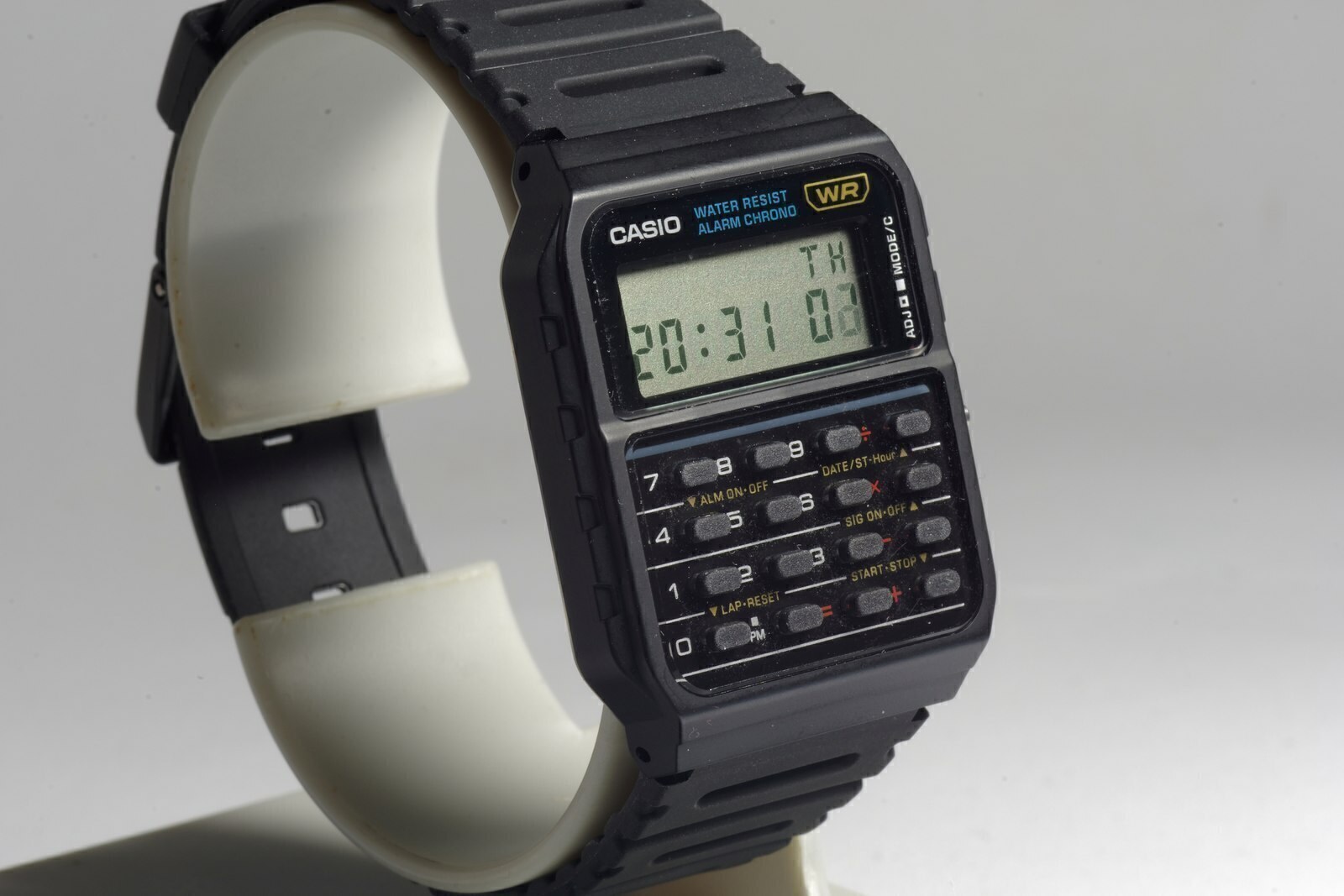
Casio is the reason the calculator watch is a category rather than a curiosity. That is a slightly odd position for a company that did not invent the calculator watch, did not invent the digital watch, and started out making cigarette holders. The story of how it got there is mostly a story about a calculator company that kept asking what else a small electronic device could be.
This page is an independent profile. There is no affiliation with Casio, and nothing here should be read as an endorsement in either direction.
The company before the watches
Tadao Kashio founded a company called Kashio Seisakujo in Mitaka, Tokyo, in April 1946, with his three brothers. Post-war Tokyo was not an obvious place to start an electronics business, and the company's first commercial success was not electronic at all: a ring-shaped cigarette holder, the yubiwa pipe, which let a smoker hold a cigarette hands-free. It sold well enough to fund the thing the brothers actually wanted to build.
That thing was a calculator. In 1957 the company released the 14-A, an all-electric compact calculator, and incorporated as Casio Computer Co., Ltd. on the same basis. The 14-A is the founding object of everything that follows: it established the company as a calculator maker, and the calculator is where its later watch designs came from.
Through the 1960s and 1970s the pattern was relentless miniaturisation and cost reduction — desktop calculators, then memory models, then the Casio Mini in 1972, which moved a calculator from office equipment to something an individual could buy. By the end of the 1980s Casio was the largest calculator manufacturer in the world by market share. The technology and the cost discipline it took to get there are exactly what a wristwatch needed.
1974: the Casiotron, and a calculator company enters watchmaking
Casio's first watch was the Casiotron, released in November 1974. The framing that produced it is the interesting part: rather than treating a watch as a display, the company treated it as a device that calculates time.
That shift produced a digital watch with an automatically correcting calendar — one that knew about month lengths and leap years without being told. Judged by later standards this sounds trivial. Judged in 1974, against watches that required the owner to correct the date five times a year, it was the kind of obvious-in-hindsight improvement that only a company thinking in terms of computation would build.
The watch industry's reaction is worth recording, because it explains a lot about the following decade. Established watchmakers saw a calculator company moving onto their ground, and some case suppliers were reluctant to work with Casio for fear of upsetting watch-brand customers. The Casiotron sold in large numbers anyway, through the electronics and department-store channels Casio already had.
1980: the C-80, and the calculator watch becomes usable
Calculator watches already existed when Casio arrived. Pulsar had released one in 1975, and Seiko and Citizen were in the market by 1980. Those early watches shared a design problem: to keep the watch looking like a watch, the keys had to be tiny, and a keypad you operate with a stylus is not a calculator you wear.
Casio's C-80, released in 1980, made the opposite trade. The keys were large enough for a fingertip, distributed between the front of the case and its sides, and the layout followed how people actually calculate — with the frequently used keys given the accessible positions rather than the tidy ones. Casio also added circuitry to work out which key you meant when you pressed two at once, which is the sort of detail that only a company with a calculator business would think to solve.
The C-80 was the model that made the format work, and it set the pattern the CA series still follows. It is also why the phrase "Casio calculator watch" is close to a tautology in most people's minds, even though the company was years behind the first example.
1983: G-Shock, and a different kind of durability
Three years later, Casio released the G-Shock DW-5000C, designed around a stated goal of surviving a ten-metre drop, ten bar of pressure and a ten-year battery life. The engineering idea — suspending the module inside the case so it floats rather than transmitting shock — was not complicated, and it changed the market for rugged watches.
G-Shock matters here for two reasons. It is the point at which Casio's watch business became a major business in its own right rather than an extension of calculators. And it established the company's most durable reputation, which is for making instruments that survive being used rather than objects that survive being looked after.
1984: Databank, and the watch as an organiser
The Databank line began in 1984 with the CD-40, which stored telephone numbers in the watch's own memory. It was a genuinely new proposition: not a calculator you could wear, but a small database you could wear, in an era when the alternative was a paper address book.
The line continued for years, with memory capacity and stored-data features expanding as chips got cheaper. The distinction that still matters when reading model numbers is this:
| Family | What it does | Interface |
|---|---|---|
| CA series | Calculator keypad, arithmetic on the display | Rows of small keys across the front of the case |
| DB / DBC series | Calculator plus stored data — numbers, schedules, memos | Fewer keys, more display area; some models fold open |
This is the corner of the market that a search for data watches is usually pointing at, even though "data watch" is not a term Casio uses. If that is what you are looking for, the model-level detail is on our Casio calculator watch guide, which covers the current CA and Data Bank references with specifications attributed to Casio's own documentation.
What Casio actually changed
Casio's contribution to watch history is not an invention, and it is not craftsmanship in the Swiss sense. It is industrialisation, in three parts:
- It treated the watch as a computing device. The automatic calendar, then the calculator, then stored data all follow from that premise rather than from watchmaking tradition.
- It solved usability, not just feasibility. The C-80's fingertip keypad is the clearest example: the technology existed, and Casio worked out how to make it usable.
- It made accuracy ordinary. By pushing digital watches down the price scale, Casio helped turn good timekeeping from a feature of expensive watches into a baseline.
The cost of that approach is visible too, and worth stating: a Casio is not a hand-finished object, its resin cases and straps age, and many of its models are designed to be replaced rather than repaired. That is a deliberate trade, not a defect, but it is why Casio collecting is a different activity from mechanical collecting — our guide to collecting covers how condition and completeness work when the material itself degrades.
Reading a Casio model reference
Casio references look like codes because they are. The parts worth knowing:
- The series letters identify the family — CA and DB/DBC for the calculator and databank lines, and separate prefixes for the other collections.
- The digits identify the model within the family, and are not sequential in any useful sense.
- The suffix is where the practical information lives: case material, band type, colourway and market variant. This is why two watches that look identical can have different references, and why buying a band for one by reference matters.
Two suffixes matter more than the rest in this corner of the catalogue. A -1 style suffix usually denotes a black or dark colourway, and a trailing letter or two often denotes a market. More importantly, the module number — which is printed on the case back and is not the same as the model reference — is what determines the instructions, the battery type and the reset procedure. A watch's model name will not tell you what cell it takes; its module number will. That is why our CA-53W manual walkthrough leads with the module number rather than the model name.
What to check before buying a Casio calculator watch
Five things, in order:
- The module number on the case back, which is the key to the manual, the battery and the water-resistance rating.
- Whether the case takes a standard strap. Many models use a moulded resin band integral to the case, so a conventional strap is not an option and lug width is not a measurement that applies.
- The water-resistance wording. "Water resistant" without a depth rating means rain and hand-washing, not swimming. Casio publishes a rating for most current models and it should be read literally.
- Whether it is current production or discontinued. Discontinued references are common on the second-hand market and are a different proposition — no warranty, and parts availability depends on the model.
- Whether the listing gives a real specification or a copy of one. Casio's own product pages and the manual are the two sources worth trusting.
For the models themselves, with the specifications set out rather than summarised, start with the Casio calculator watch guide. If you are choosing between a Casio and the obvious alternative, the Casio and Seiko comparison sets out what actually differs. And if you are weighing up a digital Casio against a smartwatch, the Apple Watch calculator page explains what the modern equivalent can and cannot do.
Frequently asked questions
Where is Casio from?
Japan. Casio Computer Co., Ltd. was founded in Tokyo — the original workshop was in Mitaka — and remains headquartered in Tokyo, in Shibuya. It is a publicly listed Japanese company and not part of a luxury watch group, which distinguishes it from most of the Swiss brands it is compared with.
When did Casio start making watches?
1974, with the Casiotron. The company had been building calculators since the 1950s, and it entered the watch market by treating a watch as a device that calculates time rather than one that displays it. That framing is why the Casiotron could automatically account for month lengths and leap years — a small thing now, and a genuine novelty in 1974.
What was Casio’s first calculator watch?
The C-80, released in 1980. Casio was not first to put a calculator on a wrist — Pulsar had done it in 1975, and Seiko and Citizen were also making calculator watches by 1980 — but the C-80 was the first to use soft buttons that could be pressed with a fingertip rather than a stylus. That decision, rather than the calculator itself, is what made the category practical.
What is a Casio Databank watch?
A digital watch with memory for data as well as a calculator. The line began in 1984 with the CD-40, which could store telephone numbers, and it turned the wristwatch into a small personal organiser years before that was an ordinary idea. Later Databank models extended the memory and added schedules and other stored data. The distinction from the CA series is that a Databank stores information while a CA model calculates.
Is Casio a luxury watch brand?
No, and that is central to what it is. Casio built its watch business on affordable digital watches and has stayed in that territory, with a few mechanical and higher-specification lines at the top of its range. Its importance in watch history is not craftsmanship in the Swiss sense but industrialisation: making accurate, useful, durable electronic watches that most people could afford.
Does Calculator Watch have any connection to Casio?
None. This site is independent and has no affiliation with, sponsorship from or endorsement by Casio Computer Co., Ltd. Casio is documented here because its models are the subject of most calculator-watch searches, and every specification we publish is attributed to Casio’s own documentation rather than to a partnership.
Models referenced in this guide
Every specification on these pages is sourced from manufacturer documentation.
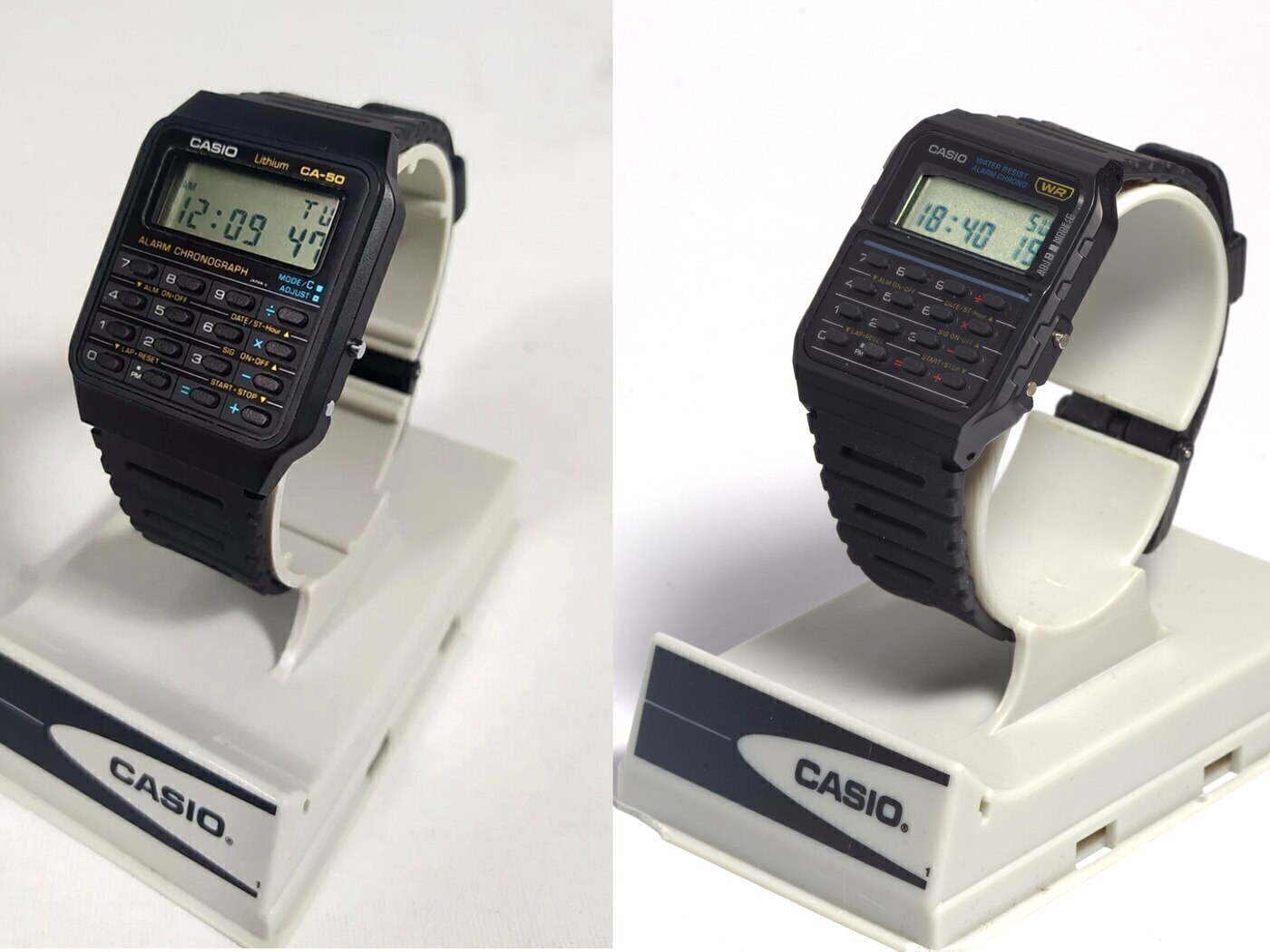
Casio CA-500WE
CA-500WE-1A
The same calculator module as the CA-53W in a chrome-plated case on a stainless steel bracelet — a dressier take that costs 28 grams in weight.
- Case
- 43.2 × 34.4 × 8.2 mm
- Weight
- 53 g
- Battery
- CR2016
- Water resistance
- Water Resistant (no depth rating published by Casio; not for swimming)
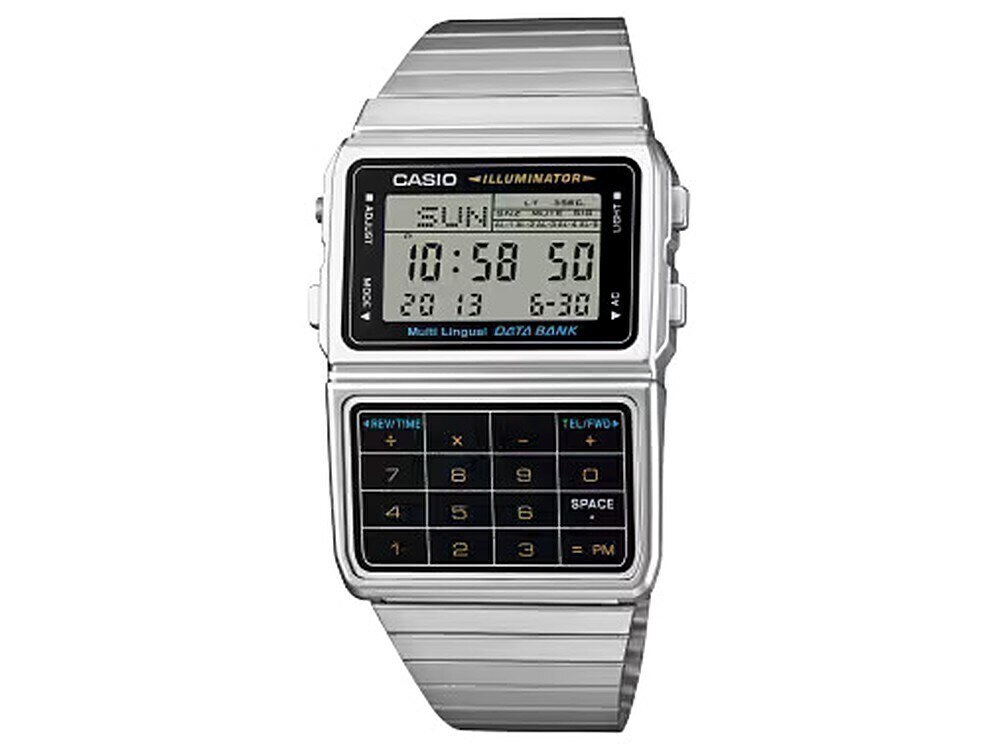
Casio DBC-611
DBC-611-1
The Data Bank calculator watch: an 8-digit calculator with currency conversion, a 25-entry phone book, five alarms and an amber LED light, on a steel band.
- Case
- 46.5 × 33.1 × 8.7 mm
- Weight
- 48 g
- Battery
- CR1616
- Water resistance
- Water Resistant (Casio publishes no depth rating)
Checked 19 Nov 2026 · Casio official site
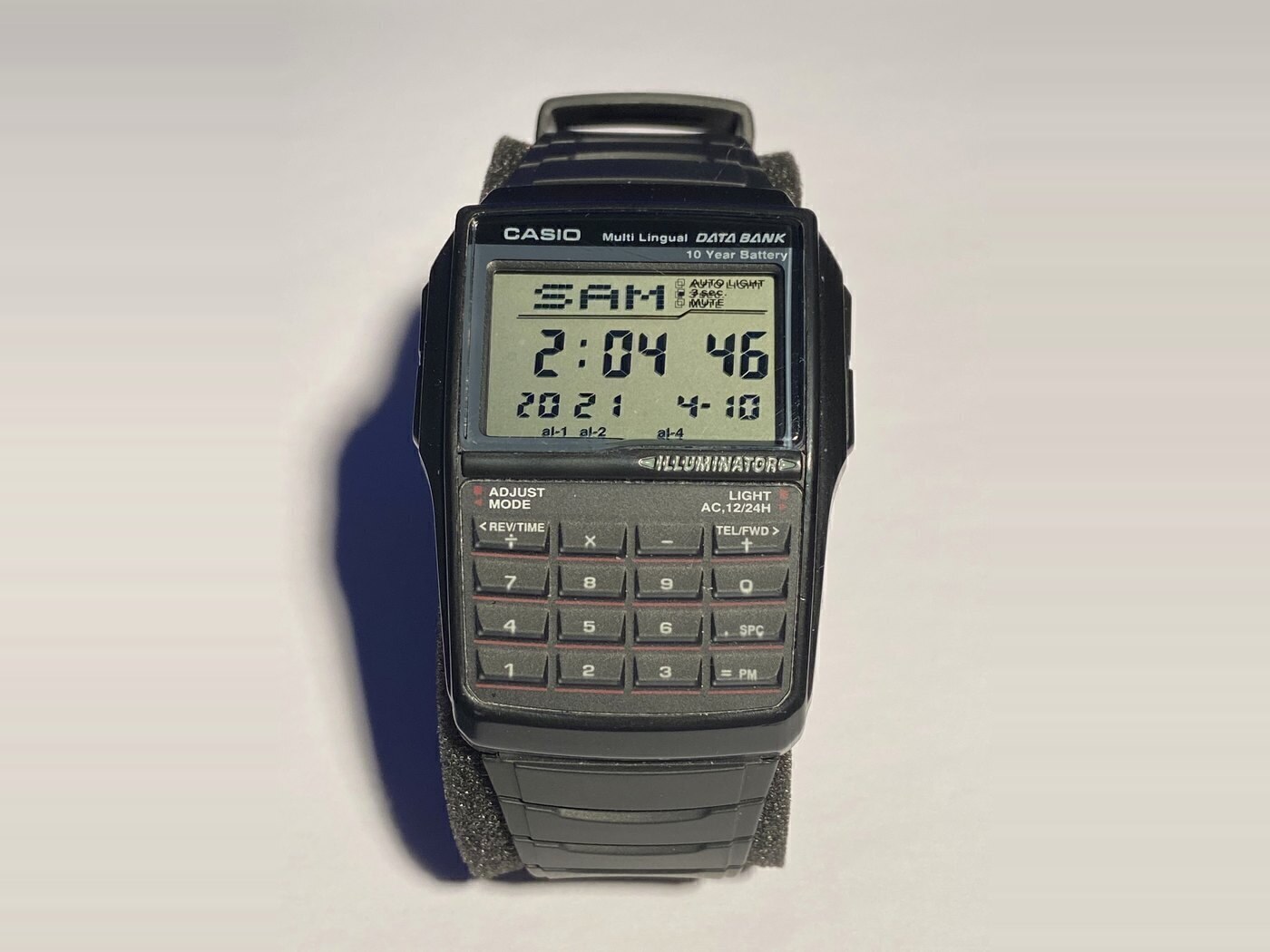
Casio DBC-32
DBC-32-1A
The chunky, resin-strapped Data Bank: same calculator, converter, telememo and ten-year battery as the DBC-611 in a wider case with a rubber band.
- Case
- 50.4 × 37.4 × 12.0 mm
- Weight
- 34 g (resin band)
- Battery
- CR2025
- Water resistance
- Listed by Casio as water resistant, without a published depth rating
Checked 19 Nov 2026 · Amazon
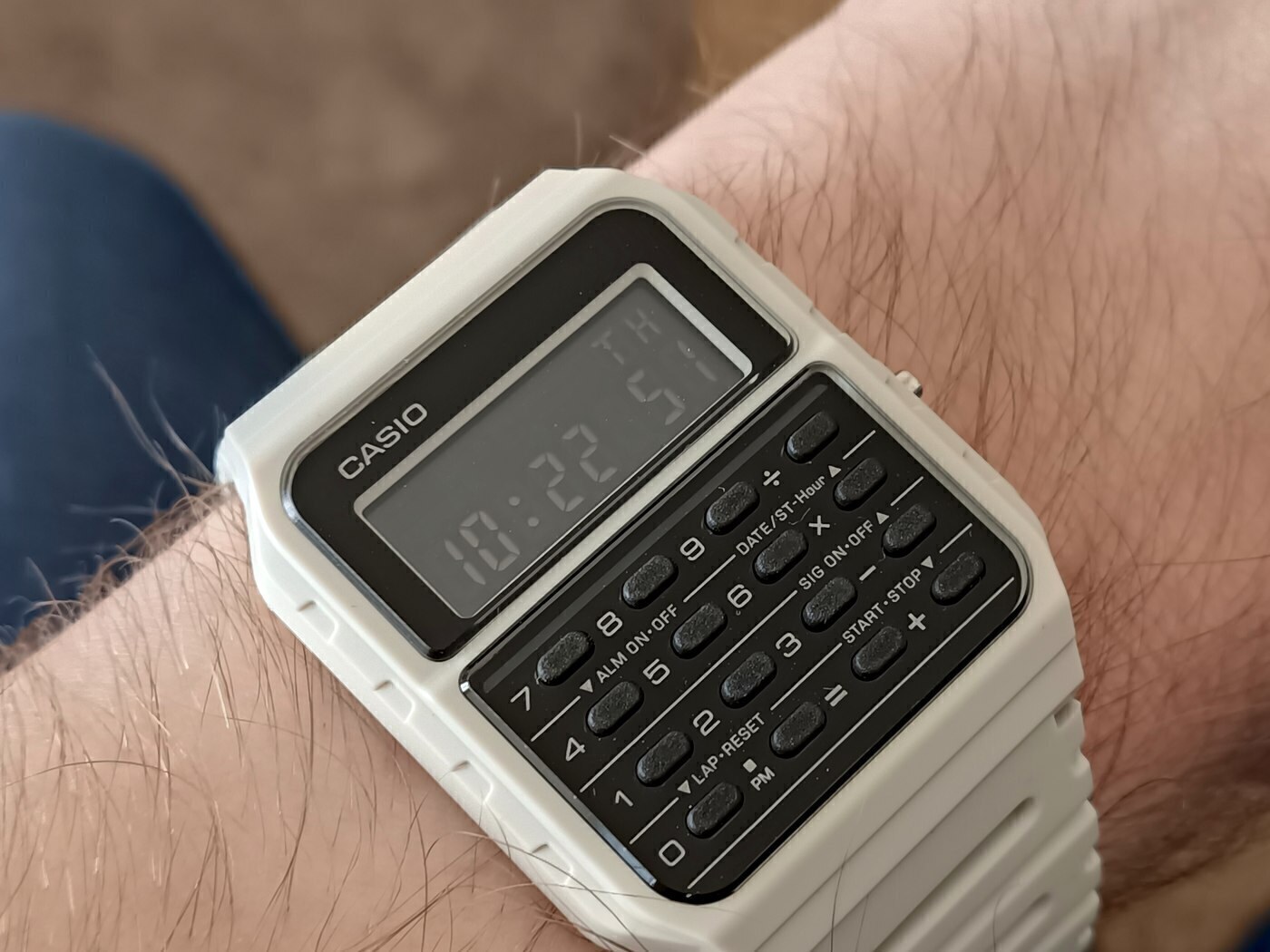
Casio CA-53WF
CA-53WF-1B / CA-53WF-3B / CA-53WF-8B
Not a different watch — the CA-53W under its colourway references. Same 43.2 mm case, same module, same calculator; different case and band colours.
- Case
- 43.2 × 34.4 × 8.2 mm
- Weight
- 25 g
- Battery
- CR2016
- Water resistance
- Water Resistant (no depth rating published by Casio)
Checked 19 Nov 2026 · Amazon
This article is editorial. Where a figure is given, it comes from the manufacturer’s published documentation and is dated on the page; where we are expressing a judgement, we say so. Something wrong? Tell us.