
Tutorial · 7 min read
Watch Lug Width: How to Measure It and Choose a Strap That Fits
Lug width is the one measurement that decides whether a strap fits, and it is routinely confused with the one measurement printed on every product page. It is not the case…
Lug width is the one measurement that decides whether a strap fits, and it is routinely confused with the one measurement printed on every product page. It is not the case diameter. It is the distance between the inside faces of the two lugs — the horns that stick out from the case to hold the spring bar — measured in millimetres. If you know that number, you can buy a strap from anyone with confidence. If you guess it, you will buy the wrong one.
What lug width actually is
A watch case has four lugs, two at twelve o'clock and two at six. A spring bar spans the gap between the pair, and the strap wraps around the bar. Lug width is the clear space between the inner faces of the lugs, which is the space the strap has to occupy.
Because lugs are usually shaped — they taper and curve — the gap is not always identical along its length, and the figure quoted in a specification is the width at the point where the strap sits. This is why a strap can feel tight at the case end and loose lower down, and why measuring in the wrong place gives a number that is a millimetre out.
How to measure it in three ways
Measure the spring bar
The most reliable method, and the one that needs the strap off. The spring bar is the pin that holds the strap, and its barrel is the width you need. Lay it against a ruler and read the figure. Because the bar is exactly as long as the gap it sits in, this avoids every ambiguity about where the lugs end.
Measure the strap you have
If the watch is already wearing a strap, measure that strap at the case end — the edge that tucks between the lugs. Do not measure at the buckle. Straps taper, so the buckle end is usually two millimetres narrower, and that is the number people mistakenly write down.
Read the specification
Manufacturer spec sheets, and most reputable listings, publish lug width as a figure in millimetres, often written as "lug width" or "band width". It is a more useful number than the case diameter and it is far more often missing, so it is worth treating its absence as a signal. Where a maker publishes diameter but not lug width, you are being told the marketing number and not the practical one.
One honest note about measuring: a ruler is accurate to about half a millimetre, which is enough, because lug widths are whole millimetres in all but a handful of cases. Calipers are better if you have them. A tape measure is worse than useless here — it flops, and it reads to a scale too coarse for the job.
Lug width is not case diameter, and the two are not related
This is the assumption that causes most wrong orders: that a bigger case means wider lugs. It does not. Lug width is a design decision about proportions, not a function of size. You will find 40 mm cases with 20 mm lugs sitting next to 38 mm cases with 22 mm lugs, in the same collection, from the same maker, in the same year.
Diameter tells you how much dial you see. Lug width tells you what you can attach to it. Neither predicts the other, and a product listing that gives one but not the other has told you half of what you need. For the fit question — whether the case suits your wrist at all — the relevant measurement is lug-to-lug, which our watch size calculator treats as the deciding figure. Lug width answers a different question: what goes between the lugs once you have bought the watch.
The sizes that actually exist
Common lug widths run from 18 mm to 24 mm, with a long tail either side. What matters is not the list but the fact that odd millimetres are real sizes rather than gaps in the range:
| Lug width | Where you meet it | Notes |
|---|---|---|
| 16 mm | Smaller dress watches, some vintage ladies' models | Thin strap stock; fewer options |
| 18 mm | Dress watches, vintage cases, smaller sports watches | The most common "small" size |
| 19 mm | Some mid-size and vintage cases | Real, but thinly stocked |
| 20 mm | Very common across dive and field watches | The default in most aftermarket ranges |
| 21 mm | Present, and the size people complain about | Available, just not everywhere |
| 22 mm | Common on larger sports and dive cases | Second most stocked after 20 mm |
| 23 mm | Less common | Specialist stock |
| 24 mm | Large and oversized cases | Thick straps to match |
Two things follow from that table. The first is that 20 mm and 22 mm dominate the aftermarket because they dominate the catalogue, so a watch in either size has more choice than a watch in 21 mm. The second is that "rare" here means commercially awkward, not collectible: a 19 mm lug width is not a feature, it is a smaller market for straps.
Tapering, and how it is written
Most straps narrow between the lugs and the buckle. This is called tapering and it is written as two numbers: 20/18 means 20 mm at the watch and 18 mm at the clasp. A two-millimetre taper is the norm. A 22 mm strap typically finishes at 20 mm, and a 24 mm strap at 22 mm. Straight straps — 20/20, 22/22 — exist and are common on rubber and on some vintage-style leather.
The taper matters for one practical reason: the buckle or deployant clasp is sized to the buckle end, not the lug end. If you buy a 22 mm strap with a taper and then try to reuse an 18 mm buckle, it will not fit. Buy the strap with its buckle, or check the buckle end width before you assume.
Why straps are listed at slightly under the nominal figure
Strap makers machine their ends a fraction under the stated width — commonly a few hundredths of a millimetre — so that the strap slots between the lugs instead of binding on them. This is not a defect or a mis-sell. It is why a "20 mm" strap slides into a 20 mm gap cleanly, and it is also why nobody should be alarmed to find the strap measures 19.9 mm on calipers.
The practical consequence is that the tolerance only goes one way. Going under by a fraction is designed in. Going over by a fraction is a struggle and going over by a millimetre is impossible. If a seller offers to send a 22 mm strap for a 21 mm watch "because it will squeeze", the answer is no.
The 21 mm problem, and what to do about it
A 21 mm lug width is one of the most common complaints in watch forums, and the reality is milder than the complaint. Three options, in order of preference:
- Buy a 21 mm strap. They exist from most serious strap makers, including in leather, rubber and nylon. This is the correct answer.
- Use a 20 mm strap and accept the gap. It fits, it holds securely, and there will be a visible sliver of spring bar at each lug. Many people do this permanently. It is not wrong, it is just not exact.
- Do not use a 22 mm strap. It will not fit without deforming something, and the thing that deforms may be the lug.
The same logic applies at 19 mm, where a 20 mm strap is the wrong direction and an 18 mm strap is the pragmatic one.
Spring bars, quick-release and the thing that fails
Spring bars come in two diameters, roughly 1.5 mm and 1.8 mm, and the thicker ones are the ones you want on a heavy watch or a thick strap. A bar that is too thin for the lug hole rattles and eventually wears the hole, which is a case repair rather than a strap change. Quick-release bars — the ones with a small lever — are convenient and are usually 1.5 mm, which is fine on a dress watch and marginal on a diver.
Spring bars are consumable. They bend, they lose tension and they fail, and the failure mode is a watch on the floor. Replacing them when you change a strap is cheap insurance, and it is the single most commonly skipped step in a strap change.
Why this matters more on a vintage or calculator watch
On a current model, a wrong strap is an inconvenience. On an older watch it can be a repair bill, because vintage lugs are thinner, sometimes drilled, and occasionally already worn at the spring bar hole. Forcing a bar into a worn hole enlarges it further.
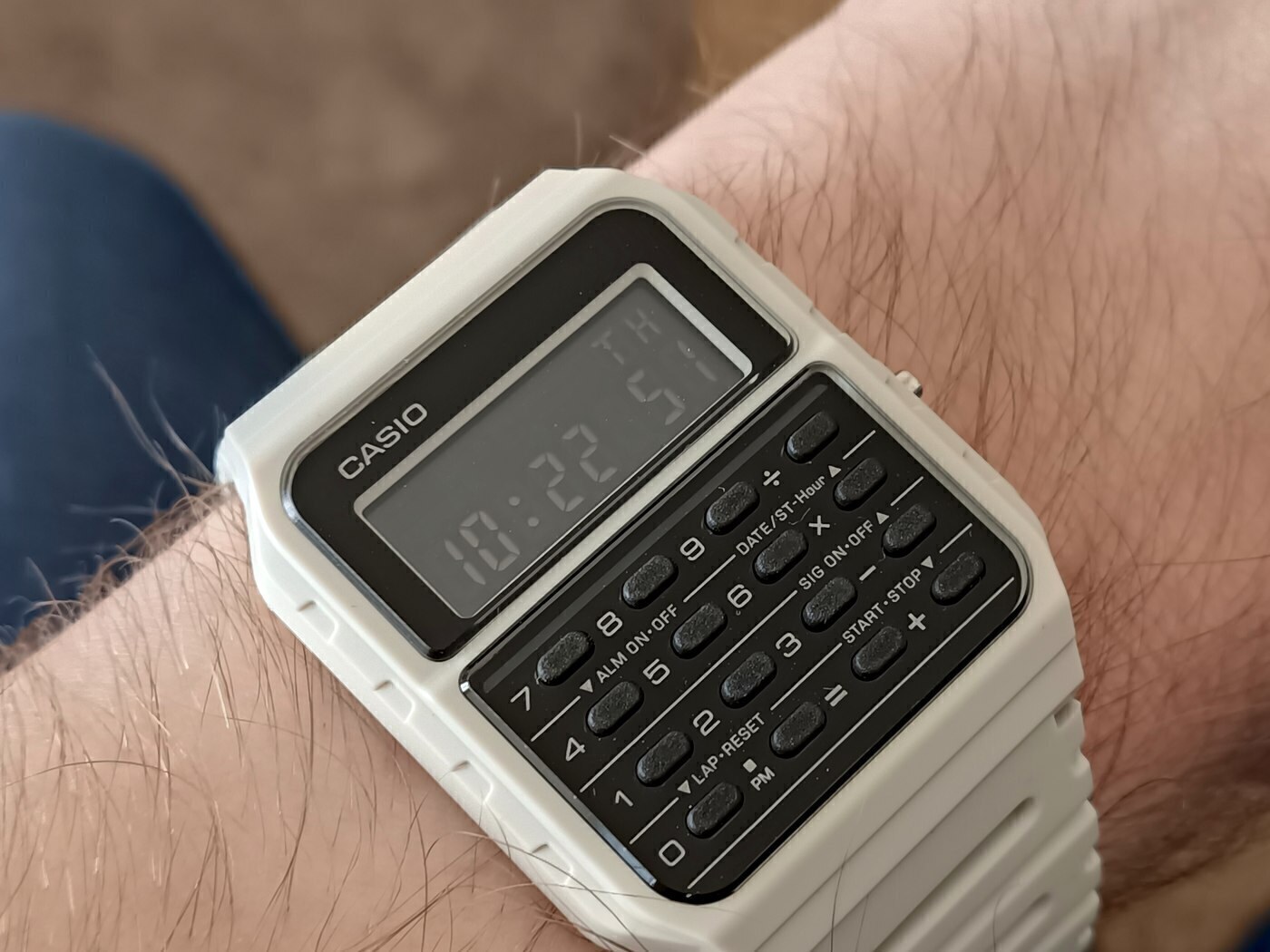
Calculator and databank watches add their own wrinkle. Many of them do not use conventional lugs at all: the resin strap is moulded to integrate with the case and is replaced as a unit, if it is replaceable at all. Where that is the case, lug width is not a figure you need — and where a model does use a standard strap, it tends to sit at the narrow end. If you are working out whether a strap is even a possibility, the model comparison and the individual model pages are the place to check what the case actually is, and the main buying guide covers the construction differences across the range.
A short checklist before you order
- Measure the spring bar or the strap at the case end, in millimetres. Write it down.
- Check the taper, so you know what buckle you will end up with.
- Check the thickness: a 4 mm strap will not pass between lugs that are 6 mm apart, whatever its width.
- Order new spring bars in the right diameter at the same time.
- Keep the strap you took off.
None of that is difficult, and all of it is cheaper than a second order. If the watch has arrived and you are still unsure whether the case suits you at all, that is a different measurement and a different page — start with the size calculator, which works from your wrist rather than the watch.
Frequently asked questions
Is lug width the same as strap width or band width?
Effectively yes, and that is why the two terms get used interchangeably. A strap is described by the width at the end that meets the watch, which has to match the lug gap. A strap can then taper — narrow — toward the buckle, so a strap sold as "20/18" is 20 mm at the lugs and 18 mm at the clasp end. When a listing says "band width" without qualification, ask which end it means.
How do I measure lug width without calipers?
Two workable methods. First, measure the spring bar: with the strap off, the bar itself is the width you need, and a ruler held against it is accurate to about half a millimetre. Second, measure the strap you already have at the point where it meets the case, not at the buckle end. A plastic ruler is fine, but line the zero mark up on an edge rather than the edge of the ruler, which is usually offset by a millimetre or two.
What if my watch has 21 mm lugs and I can only find 20 mm straps?
A 20 mm strap will fit a 21 mm gap and will leave a visible sliver of space on each side between the strap and the lug. It holds, and many people live with it, but it is not the correct fit and it puts the spring bar under a slight sideways load. A 22 mm strap will not fit at all without compressing the lugs. The right answer is a 21 mm strap, which is a real size and easier to find than its reputation suggests.
Can I fit a wider strap by squeezing it?
No. Lugs are rigid and a strap that is too wide has nowhere to go. Forcing it risks scratching the case, bending the spring bar, and in the worst case cracking the lug itself. If the width is wrong by more than half a millimetre, the strap is wrong.
Does changing the strap change what the watch is worth?
On a modern watch, usually not, as long as the original strap or bracelet is kept and goes with the watch. On a vintage or collectible piece the original strap, buckle and bracelet are part of the object, and selling the watch without them costs more than the strap is worth. Keep the original, wear the replacement. Our valuation worksheet treats completeness as one of the five things that decide value.
Do calculator watches have a normal lug width?
Often not. Many calculator and databank models use a moulded resin strap that is part of the case assembly rather than a conventional strap between lugs, so there is no lug gap to measure and no standard strap to fit. Where a model does take a conventional strap, it is usually on the narrower side. Check the model's published specification or measure the existing strap rather than assuming a figure.
This article is editorial. Where a figure is given, it comes from the manufacturer’s published documentation and is dated on the page; where we are expressing a judgement, we say so. Something wrong? Tell us.